Curling iron vs wand comes down to the curl you want. A curling iron’s clamp gives even, defined curls and is easier to control; a wand has no clamp and gives looser, more undone waves. Choose a 1 inch barrel for soft curls on shoulder-length hair and 1 1/4 to 1 1/2 inches for long hair, and start at the lowest heat that holds your curl, using a heat protectant.
Curling Iron vs Wand: Barrel Size and Heat Styling Temperature Guide
Curling iron vs wand is the first choice for curls, and barrel size is the second. Get them right and your curls hold through a wedding day; get them wrong and they drop by lunch or turn out tighter than you wanted. This guide asks about your hair length, the curl you want, your strand thickness and your hair’s condition, then shows the barrel size in inches and millimeters, whether a curling iron or a wand suits the look, and a general heat band to start from.
It gives bands, never one exact temperature, because no published source supports a single right number for everyone.
Curling iron or wand, and which barrel?
Answer four quick questions about your hair length, the curl you want, strand thickness and condition. You’ll see the barrel size in inches and millimeters, whether an iron or a wand suits it, a general heat band to start from, and the technique.
Your privacy: Everything you enter stays on your device. This page does not send, save, or share your answers, and you do not need an account or an email address. If you copy a share link, your answers are stored inside the link, so only share it with people you trust.
Heat styling can dry and weaken hair. Start at the lowest temperature that works for your hair, use a heat protectant, and ask your stylist if you are unsure what suits your hair.
Hair products and treatments can change how hair looks and feels, but they do not guarantee repair or growth. For color, chemical services, or scalp concerns, check with a licensed stylist or a doctor.
This page is general beauty education. It is not styling, cosmetic, dermatological, or medical advice.
Curling iron vs wand: what’s the difference?
A curling iron has a clamp that holds the hair against the barrel. That makes it easier to control, and it gives even, defined curls from the mid-lengths to the ends, which is why many stylists reach for one for polished wedding curls. A curling wand has no clamp: you wrap the hair around the barrel and hold the end. The result is a looser, more lived-in wave with no crimp at the ends, and tapered wands give curls that are tighter at the ends than at the root. Wands take a little practice, and most come with a heat glove for a reason.
The guide suggests an iron for tight curls, either tool for soft curls and a wand for loose waves. That’s convention, not a rule; plenty of people make beach waves with an iron by leaving the ends out.
How the curling iron vs wand guide works
Your hair length and the curl you want set the barrel size. Strand thickness adjusts it: thick or heavy hair tends to drop, so the guide goes one size smaller to keep the curl. Thickness also sets a starting heat band, and your hair’s condition can move that band down, since colored, lightened or often heat-styled hair is more fragile. The barrel table and the heat bands are both on this page, so you can check every result by hand.
Choosing your barrel size
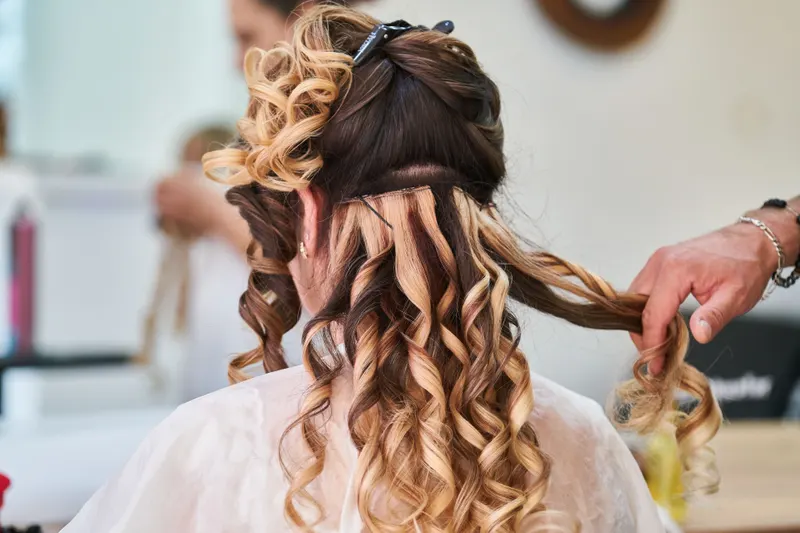
Barrel size is the biggest factor in how a curl looks. A 3/4 inch (19 mm) barrel makes tight, springy curls and suits short hair. A 1 inch (25 mm) barrel is the most versatile, giving soft curls on shoulder-length hair and tighter curls on long hair. A 1 1/4 inch (32 mm) barrel makes bouncy curls on long hair and loose waves on medium lengths. A 1 1/2 inch (38 mm) or 2 inch (50 mm) barrel gives big, loose waves and volume on long hair, but the curl relaxes quickly on fine hair.
| Length | Tight curls | Soft curls | Loose waves |
|---|---|---|---|
| Chin length or shorter | 3/4 in (19 mm) | 1 in (25 mm) | 1 in (25 mm) |
| Around the shoulders | 3/4 in (19 mm) | 1 in (25 mm) | 1 1/4 in (32 mm) |
| Below the shoulders | 1 in (25 mm) | 1 1/4 in (32 mm) | 1 1/2 in (38 mm) |
| Mid-back or longer | 1 in (25 mm) | 1 1/2 in (38 mm) | 2 in (50 mm) |
Longer hair needs a larger barrel for the same look, because each section wraps around the barrel more times. If you’re between two sizes, choose the smaller one: curls always relax a little over the day.
Heat styling temperature: why bands, not numbers
Studies of hot styling tools show how wide the range is. A study of curling irons measured temperatures from 80 to 300 degrees Celsius across the tools tested, with a more typical range of 130 to 170 degrees, and found that timing matters as much as heat. Research on flat irons notes that tools running above 200 degrees can do significant damage to the keratin in hair. Beyond that, the safe level depends on your hair, how long the heat touches it, whether it’s damp and whether you use a protectant, so no single setting fits everyone.
| Band | Fahrenheit | Celsius | Usually for |
|---|---|---|---|
| Low | 250 to 300 F | 120 to 150 C | Fine, fragile, lightened, colored or often heat-styled hair. |
| Medium | 300 to 350 F | 150 to 175 C | Medium, healthy hair that holds a style. |
| High | 350 to 390 F | 175 to 200 C | Coarse or very resistant hair only, with short contact and a heat protectant. |
Use the band as a starting point. Begin at the bottom of it, curl a test section, and go up only if the curl doesn’t hold. The numbers on your tool may not match the actual barrel temperature, so trust how your hair responds more than the display.
Fine, coarse, colored and lightened hair
Fine hair heats through quickly, so it usually needs less heat and only a second or two of contact; pinning each curl while it cools helps it hold. Coarse or thick hair may need more heat to set, but give each section a short, steady hold rather than a long one. Colored, lightened and often heat-styled hair is more fragile, so the guide moves it down a band. Lightened and gray hair can also yellow with too much heat, which is another reason to keep it low.
Technique for curls that last
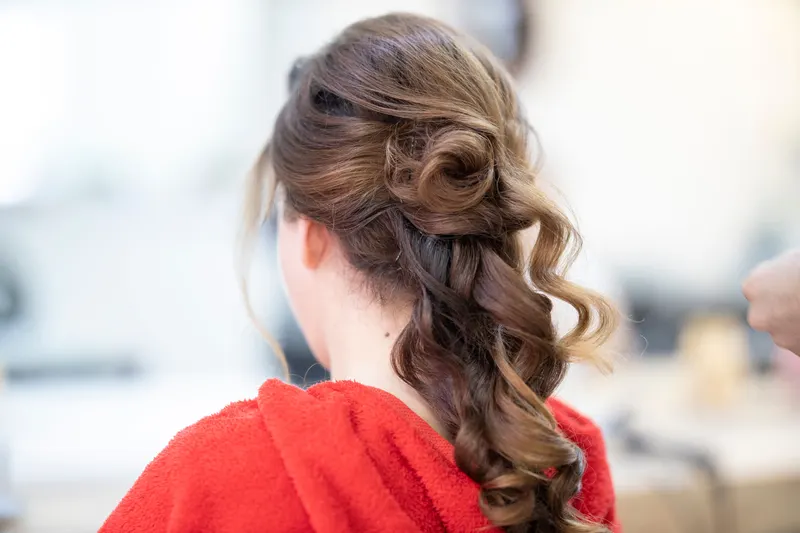
Start with completely dry hair, since heat on damp hair can make water boil inside the strand. Apply a heat protectant, then work in sections about as wide as the barrel. Wrap each section away from your face, hold for only a second or two, as the American Academy of Dermatology advises, and let the curl fall into your hand. Let every curl cool completely before you touch it; pinning curls in place while they cool sets them much more firmly. Brush or finger out the curls only once your whole head is cool, and finish with a light, flexible hairspray. Dermatologists also suggest using hot tools once a week or less, so save full curls for the days that count, like a wedding or a photoshoot.
Curling short, medium and long hair
Short hair, at chin length or above, has only enough length to wrap around a barrel once or twice, so a smaller barrel and small sections make the curl visible. Leave the last half inch out of the barrel for a modern, piecey finish. Medium hair, around the shoulders, is the easiest length to curl: a 1 inch barrel gives soft curls and a 1 1/4 inch barrel loose waves. Long hair wraps around the barrel many times, so curls look tighter at the top and need a bigger barrel for the same look; the weight of long hair also pulls curls down, which is why pinning while they cool makes such a difference. Alternate the direction of each section, away from and toward the face, for a more natural look, or curl everything away from the face for a classic, polished finish.
Wedding curls that hold
For a wedding, curls need to last ten hours or more, through heat, humidity and hugs. Stylists usually curl with a slightly smaller barrel than the final look, pin each curl to cool, and brush them out at the last moment. If your hair drops curls quickly, ask your stylist about prep products that add grip, and wash your hair when they suggest, since very freshly washed hair can be too slippery to hold a curl. Test your plan at your trial and check how the curls look at the end of the day.
Frequently asked questions
Is a curling iron or wand better?
An iron is easier to control and gives defined curls. A wand gives looser, more undone waves and takes a little practice.
What size curling iron for loose waves?
Usually 1 1/4 inches (32 mm) on medium hair and 1 1/2 inches (38 mm) or larger on long hair. A wand gives the softest, most undone finish.
What size barrel for long hair?
1 to 1 1/4 inches for curls and 1 1/2 to 2 inches for waves. Go one size smaller if your hair is thick.
What temperature should I curl my hair at?
Start at the lowest heat that holds your curl. As a general band, fine or fragile hair usually needs less heat than coarse hair.
Why do my curls fall out?
Often the barrel is too big, the section too thick, or the curl was touched before it cooled. Pinning curls while they cool helps.
Can Reign Beauty Collective curl my hair for my wedding?
Yes. Our stylists choose the right barrel and heat for your hair and set curls to last all day.
Sources
The heat bands are broad and general, anchored to the Journal of Cosmetic Science papers below on how hot styling tools run and when hair keratin starts to suffer, and the hold time, lowest-setting and how-often advice follows the American Academy of Dermatology. No published source gives one right temperature for each hair type, so none is given here. Barrel sizes are common styling convention.
- The effect of various cosmetic pretreatments on protecting hair from thermal damage by hot flat ironing (Zhou, Rigoletto, Koelmel and others, Journal of Cosmetic Science 62(2):265-282, 2011), Society of Cosmetic Chemists library. library.scconline.org/v062n02/180 (retrieved 2026-10-11)
- Thermal degradation of hair. I. Effect of curling irons (Journal of Cosmetic Science 49(4), 1998), Society of Cosmetic Chemists library. library.scconline.org/v049n04/12 (retrieved 2026-10-11)
- Hair styling without damage, American Academy of Dermatology. www.aad.org/public/diseases/hair-loss/hair-care/styling (retrieved 2026-10-12)
- How to stop damaging your hair, American Academy of Dermatology. www.aad.org/public/diseases/hair-loss/insider/stop-damage (retrieved 2026-10-12)
Last reviewed October 12, 2026 by the Reign Beauty Collective artist team, Tampa, Florida.
This page is general educational content from Reign Beauty Collective in Tampa, Florida. It is not professional, medical, or financial advice, and results vary. Please talk with a licensed professional about your own situation.