Your hair type is really four things: the texture or curl pattern, how thick each strand is, how much hair you have, and how readily it takes in water. Texture runs from straight to wavy, curly and coily. Knowing all four helps you choose how often to wash, how to condition and style, and how to prepare your hair for an updo or curls.
Hair Type Quiz: Your Texture, Thickness, Density and Routine
This hair type quiz goes further than a curl chart. It asks how your hair dries, how a single strand feels, how easily you can see your scalp and how your hair takes in water, then scores each part on its own, so your result reads like a description of your actual hair rather than a single label.
You also get a simple routine outline and a note on getting ready for a wedding style. There are no product picks and no brands, and every point the quiz gives is shown in the table further down this page.
Take the hair type quiz
Answer a few questions about how your hair dries, feels and takes in water. You’ll get your texture, strand thickness, density and a rough porosity guess, plus a simple routine outline and wedding styling prep. No products, no brands.
Your privacy: Everything you enter stays on your device. This page does not send, save, or share your answers, and you do not need an account or an email address. If you copy a share link, your answers are stored inside the link, so only share it with people you trust.
Hair products and treatments can change how hair looks and feels, but they do not guarantee repair or growth. For color, chemical services, or scalp concerns, check with a licensed stylist or a doctor.
Use these results as a starting point, not a verdict. Lighting, your screen settings, and your own answers all shape what you see, and an in-person consultation with a trained artist is the best way to confirm what flatters you.
This page is general beauty education. It is not styling, cosmetic, dermatological, or medical advice.
How the hair type quiz works
The first two questions are about texture: how your hair dries without product or heat, and how much it shrinks as it dries. A third asks how big the waves, curls or coils are, which only sets the letter on the familiar 1 to 4 chart. Then come single questions on strand thickness and density, three on how your hair takes in water, and two optional checklists for your hair history and goals.
Each part is scored separately. An answer about your scalp only changes your density, and an answer about water only changes your porosity guess. That keeps the result honest: if you skip a question, that part simply stays blank instead of being guessed from something unrelated. If your texture answers are close between two types, the quiz tells you, because many heads of hair have more than one pattern.
Texture: straight, wavy, curly or coily
Texture describes the shape of your hair as it dries naturally. Straight hair falls from root to tip and lets scalp oil travel down quickly, so it can look flat sooner and tends to let curls drop. Wavy hair has a loose S-shaped bend and is easy to weigh down. Curly hair forms defined curls or ringlets that need moisture to stay defined. Coily hair forms tight coils or a zigzag with a lot of shrinkage, and it’s often the most fragile when dry.
The quiz describes hair by its texture and its care needs, never by who has it. Every texture appears on every kind of head, and plenty of people find their hair changes with length, weather, color and hormones.
| Question | Answer | Points |
|---|---|---|
| How does your hair dry with no product and no heat? (texture) | Straight, from root to tip | Straight +3 |
| Mostly straight with a slight bend | Straight +1, Wavy +2 | |
| Loose S-shaped waves | Wavy +3 | |
| Defined curls or ringlets | Curly +3 | |
| Tight coils, kinks or a zigzag pattern | Coily +3 | |
| When it dries, does it look shorter than when it’s wet? (texture) | No, about the same length | Straight +2, Wavy +1 |
| A little shorter | Wavy +1, Curly +2 | |
| Much shorter | Curly +1, Coily +3 | |
| Roll a single strand between your fingers. How does it feel? (thickness) | I can barely feel it | Fine strands +3 |
| I can feel it, like a cotton thread | Medium strands +3 | |
| Thick or wiry | Coarse strands +3 | |
| With your hair dry and down, how easily can you see your scalp? (density) | Easily | Low density +3 |
| A little, around the part | Medium density +3 | |
| Hardly at all | High density +3 | |
| When you wet your hair, how quickly does it get soaked? (porosity) | Slowly, water seems to sit on top | Lower porosity +2 |
| In a few moments | Medium porosity +2 | |
| Almost instantly | Higher porosity +2 | |
| How do leave-in products feel on your hair? (porosity) | They sit on top or feel greasy | Lower porosity +2 |
| They absorb and feel fine | Medium porosity +2 | |
| They vanish and my hair feels dry again soon | Higher porosity +2 | |
| How long does your hair take to air-dry? (porosity) | A very long time | Lower porosity +1 |
| A few hours | Medium porosity +1 | |
| Surprisingly fast | Higher porosity +1 | |
| History: Color or lightening | Ticked | Higher porosity +2 |
| History: Relaxing, perming or keratin smoothing | Ticked | Higher porosity +2 |
| History: Heat styling most weeks | Ticked | Higher porosity +2 |
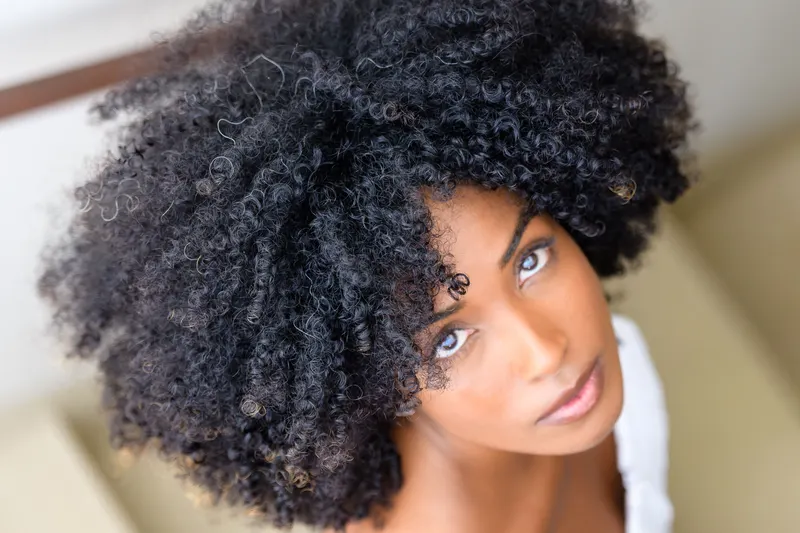
What the 1 to 4 hair chart means
The popular hair chart numbers textures from 1 for straight to 4 for coily, and adds a letter from A to C for the size of the pattern, from big and loose to small and tight. It’s a handy shorthand, so the quiz shows your rough label. It isn’t science, though. It only describes curl shape, it says nothing about thickness, density or how your hair behaves, and most people’s hair spans two or more labels across the head.
Use the label to find advice written for hair like yours, and use the rest of your result to decide what actually suits it.
Strand thickness and density are different
Thickness is the width of a single strand. Fine strands are easy to weigh down and slip out of pins, medium strands hold most styles, and coarse strands are strong but slow to dry and style. Density is how many strands you have. Fine hair can be dense, and coarse hair can be sparse, which is why someone with very fine hair can still have a lot of it.
Both matter for styling. Fine, low-density hair often needs added texture and volume to fill out an updo, while coarse, high-density hair needs more pins, more sectioning and more time.
Why the porosity result is only a rough guess
Porosity describes how readily hair takes in and loses water. The quiz asks about how fast your hair gets soaked, how leave-in products feel and how long it takes to dry, and adds points if your hair has been colored, chemically straightened or regularly heat styled. That gives a useful hint, but home porosity tests, including the popular glass-of-water test, mostly pick up wear on the surface of the hair rather than measuring porosity directly.
So the quiz labels porosity as a rough guess. The best test of any product is to try it on a strand or a small section of your own hair and see how it looks and feels once dry.
Your hair type quiz routine outline
The routine follows dermatologist guidance and your result. Straight hair with an oily scalp can be washed daily, while textured, curly and coily hair usually needs washing far less often, and too much washing can leave curls dry and frizzy. Shampoo goes on the scalp rather than the whole length. Fine hair is best conditioned at the ends, while dry or curly hair benefits from conditioner along its full length.
Detangle wet hair with a wide-tooth comb rather than a brush, and avoid brushing curls and coils when they’re dry. Blot hair with a towel or T-shirt instead of rubbing, keep heat tools on low or medium with a heat protectant, and if your hair is coily, satin or silk at night reduces friction.
Layering moisture for curls and coils
Curly and coily hair often feels driest, because natural oils travel down a coiled strand more slowly. Many people with natural hair layer products after washing in one of two common orders. In the LOC order, a water-based leave-in (the liquid) goes on first, then an oil, then a cream to seal and define. In the LCO order, the cream goes before the oil, which some people find lighter on fine or low-porosity hair. Neither is a rule: try both on wash day and keep the one that leaves your hair soft rather than greasy the next morning. Leave-in products are made to stay in without rinsing and help detangling on curly hair, but they can build up, so an occasional clarifying wash keeps the layers working.
What is hair grease? Hair grease is a thick product made mainly from oils and waxes, often with petrolatum or mineral oil, that many people with coily hair use on the lengths, edges or scalp. It doesn’t add moisture by itself; it forms a film on the outside of the strand that lubricates it and slows water loss, which is why it’s usually used to seal after a water-based product rather than on its own. A little goes a long way, and on fine or straight hair it can look oily. If your scalp is itchy, flaky or sore, ask a dermatologist before adding heavy products to it.
Preparing your hair type for a wedding style
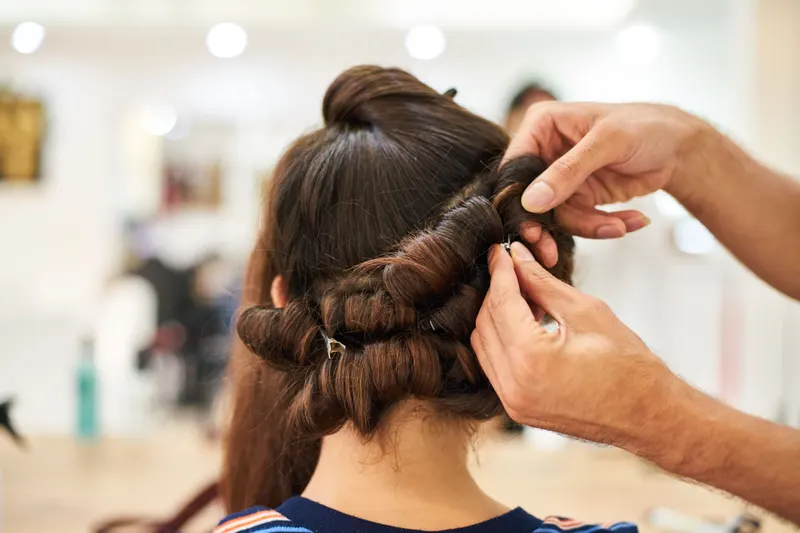
Most generic hair type quizzes stop at a wash routine. For a wedding, the more useful question is what your hair needs to hold a style for a long day. Straight and fine hair often needs the most help: set curls, added texture and a little grip so pins don’t slide. Wavy hair usually takes curls well. Curly and coily hair can be styled in its natural texture, stretched or smoothed, and each choice changes how long the morning takes.
Ask your stylist how they want your hair on the day, freshly washed or washed the day before, with or without product, because preferences vary with texture and style. Bring your result to your trial: telling a stylist your texture, thickness and density up front helps them plan pins, products and timing.
When your hair changes
Hair isn’t fixed. Color and lightening, chemical straightening, regular heat, hormones, medication and the seasons can all change how your hair looks and behaves. If your result surprises you, take the quiz again after your next wash, with no product in your hair. If you notice sudden shedding, thinning or scalp changes, that’s a question for a doctor or dermatologist rather than a hair quiz.
Frequently asked questions
What is my hair type?
Your hair type combines texture, strand thickness, density and porosity. The quiz above scores each one separately from simple questions about how your hair dries, feels and takes in water.
How do I know if my hair is wavy or curly?
Let it dry with no product and no heat. Loose S-shaped bends are wavy, while defined curls or ringlets that shrink as they dry are curly, and many people have a mix of both.
Is the hair porosity float test accurate?
Not very. It mostly shows wear on the surface of the hair rather than how much water the hair takes in, so trying a product on a strand of your own hair is a better guide.
How often should I wash my hair?
It depends on your hair and scalp. Straight hair with an oily scalp can be washed daily, while curly and coily hair usually needs washing much less often.
Does my hair type change?
It can. Color, chemical services, heat, hormones and the seasons can all change how your hair behaves, so retake the quiz if your hair starts acting differently.
Does Reign Beauty Collective style every hair texture?
Yes. Reign Beauty Collective’s stylists work with every texture and thickness, and they plan your wedding style around how your hair really behaves.
Sources
The washing, conditioning, detangling and heat advice follows the American Academy of Dermatology pages below, and the porosity caution follows the cosmetic chemistry article. Every point the quiz gives is in the scoring table on this page.
- Tressed to impress: tips for keeping your mane magnificent, American Academy of Dermatology (August 13, 2024). www.aad.org/news/tressed-to-impress-hair-tips (retrieved 2026-10-10)
- 6 curly hair tips from dermatologists, American Academy of Dermatology (June 30, 2022). www.aad.org/news/6-curly-hair-tips-from-dermatologists (retrieved 2026-10-10)
- Hair porosity tests are a lie, Lab Muffin Beauty Science, Michelle Wong PhD (January 28, 2026). labmuffin.com/hair-porosity-tests-are-a-lie (retrieved 2026-10-10)
- Hair Cosmetics: An Overview (Dias, International Journal of Trichology, 2015), PubMed Central, U.S. National Library of Medicine. pmc.ncbi.nlm.nih.gov/articles/PMC4387693 (retrieved 2026-10-11)
Last reviewed October 10, 2026 by the Reign Beauty Collective artist team, Tampa, Florida.
This page is general educational content from Reign Beauty Collective in Tampa, Florida. It is not professional, medical, or financial advice, and results vary. Please talk with a licensed professional about your own situation.